SaaS
SaaS vs Traditional Software
Quick Answer
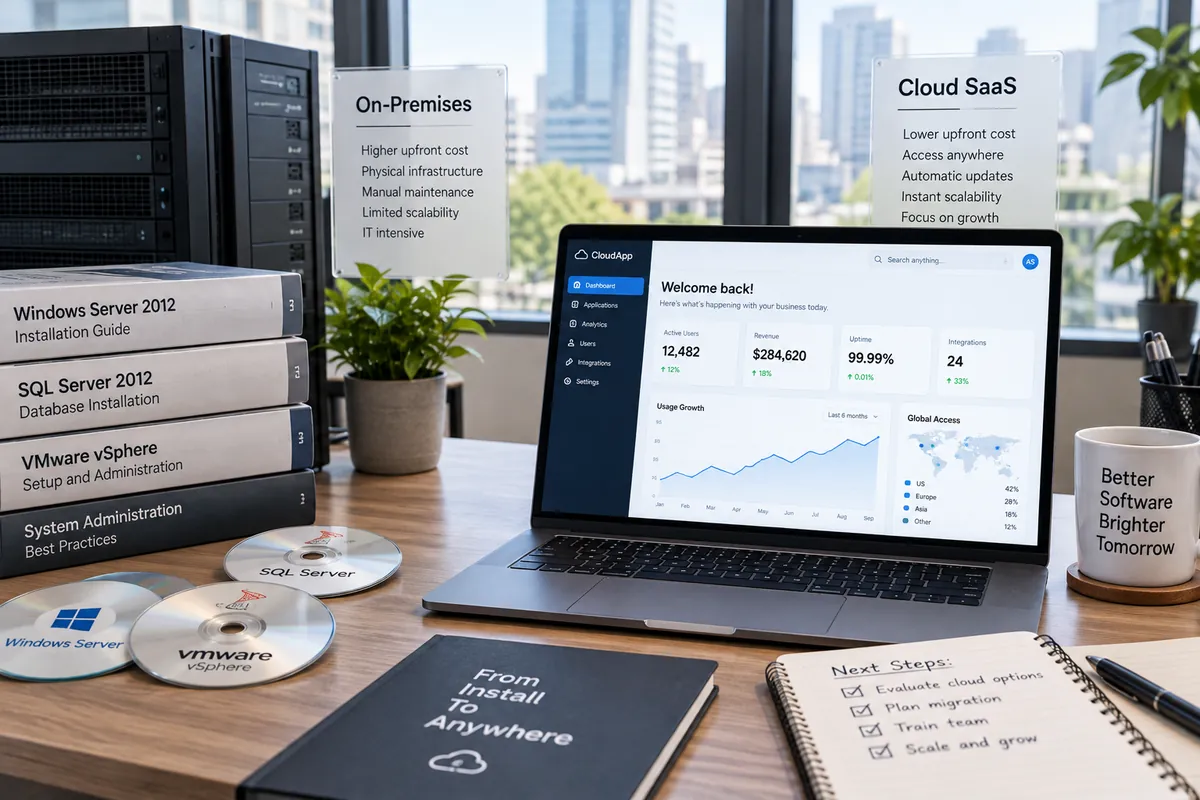
SaaS is rented, hosted by the vendor and updated automatically; traditional software is bought or licensed, installed on your own machines or servers, and maintained by you. SaaS suits most businesses for speed and low upfront cost, while traditional software suits strict data control, offline use or heavy customisation.
Introduction
Before cloud subscriptions, businesses bought software licences, installed them on office computers or servers and paid for upgrades every few years. Many still run systems this way, alongside newer SaaS tools.
This comparison explains the practical differences and when each model makes sense.
Cost model
Traditional software usually involves a large upfront licence, optional annual maintenance and hardware costs. SaaS spreads cost into subscriptions, which lowers the barrier to start but continues indefinitely. Over many years, either can be cheaper depending on team size and how long you keep the software.
Deployment and updates
SaaS is ready to use after sign-up, and updates arrive automatically. Traditional software needs installation, configuration and planned upgrades, which gives you control over timing but often leaves systems running outdated versions.
Security and data control
With SaaS, the vendor secures the infrastructure and your data sits in their cloud. With on-premise software, data stays on your premises, which some regulated industries prefer, but you are fully responsible for security, backups and patching.
Customisation and integration
Traditional software can often be customised deeply, sometimes at the cost of difficult upgrades. SaaS products offer configuration and APIs but limit core changes. Modern SaaS usually integrates more easily with other cloud tools.
How to choose
Choose SaaS when speed, remote access and low maintenance matter most. Choose traditional or self-hosted software when you need offline operation, full data control, deep customisation or have regulatory constraints. Many businesses use a mix, and custom software can sit in between, hosted in your own cloud account.
Compare responsibility, access and operating control
With SaaS, a provider operates a centrally hosted service and customers access it over a network. Traditional software may be installed and operated by the customer, though many products combine desktop, hosted and managed components. The label alone does not tell you who patches a system, where data resides or how an outage is handled; read the actual service and support terms.
Compare integration needs, data control, offline use, update cadence, customization, exit options and the team needed to administer each model. Related guides cover SaaS fundamentals, SaaS product cost drivers and Vaqnova’s SaaS project service.
A hosted subscription may reduce local deployment work while adding recurring charges and dependence on the provider’s service. A self-managed product may offer more control while requiring internal operations. Evaluate the complete ownership model for the specific product and contract.
Summary
Key Takeaways
- SaaS lowers upfront cost and maintenance; traditional software gives more control.
- Compare total cost over the period you expect to use the software.
- Regulatory and offline needs can favour on-premise or self-hosted options.
- A mix of SaaS, traditional and custom software is common and reasonable.
SaaS vs traditional software
| Factor | SaaS | Traditional software |
|---|---|---|
| Payment | Subscription | Upfront licence plus maintenance |
| Hosting | Vendor's cloud | Your computers or servers |
| Updates | Automatic | Planned upgrades by you |
| Access | Anywhere via browser or app | Mostly on-site or via VPN |
| Customisation | Configuration and APIs | Often deeper, with upgrade risk |
| Data control | Shared with vendor | Fully in-house |
Pitfalls
Common Mistakes to Avoid
- Comparing a SaaS monthly price with a one-time licence without counting years of use.
- Running unpatched on-premise software to avoid upgrade costs.
- Moving to SaaS without planning data migration and training.
- Assuming on-premise is automatically more secure.
FAQ
Frequently Asked Questions
Is SaaS cheaper than traditional software?
Usually at the start. Over long periods with many users, a licence can sometimes cost less, but you then carry hardware, maintenance and upgrade costs.
Can traditional software run in the cloud?
Yes. Many businesses host licensed software on cloud servers, gaining remote access and managed infrastructure while keeping the same application.
Which is better for data privacy?
Either can be compliant. SaaS vendors with Indian data centres and strong certifications can meet most needs; on-premise gives maximum control but needs strong internal security.
Can I move from on-premise to SaaS?
Yes, with planning for data migration, integrations, user training and a period of parallel running.
Wrap-up
Final Thoughts
Neither model is universally better. SaaS wins on convenience and speed, traditional software on control. Choose per system, based on cost over time, data requirements and how much you need to customise.
References
Sources
Let's talk
Build Your Next Digital Product
Vaqnova can help you decide between SaaS, traditional and custom software for each part of your business and handle the migration.
Talk to Our Team