Agentic AI
What is an AI Agent? Complete Beginner Guide

Quick Answer
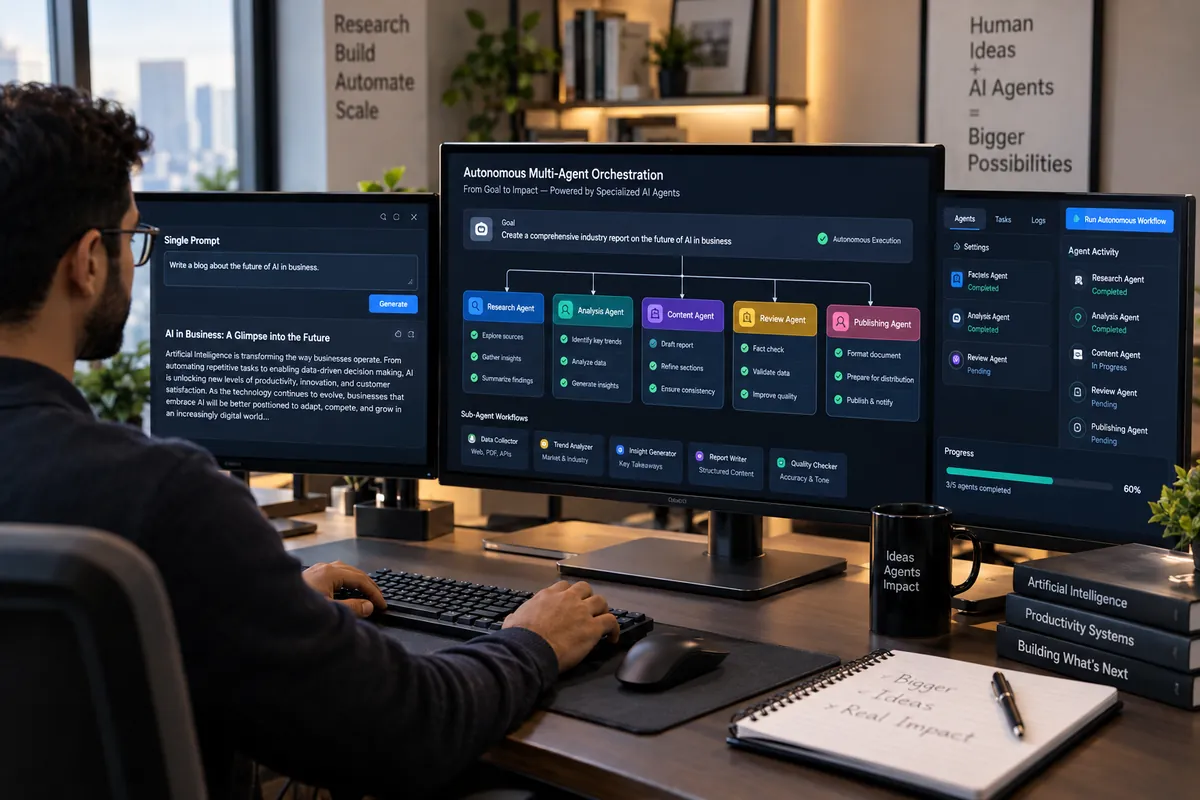
An AI agent is software that uses a large language model to pursue a goal by planning steps, calling tools such as databases, APIs or search, checking the results and continuing until the task is done. Unlike a chatbot that only answers, an agent takes actions within the permissions you give it.
Introduction
AI agents are one of the most discussed developments in business technology. The idea is simple: instead of asking an AI a question and copying the answer somewhere, you give it a goal and the tools to act, and it completes the work.
This beginner guide explains how agents work, what they are good at today, where they still need human oversight, and how a business can start using them responsibly.
How an AI agent works
Most agents combine five ingredients:
- A language model that reasons about the goal and decides the next step.
- Tools: functions the agent can call, such as searching a knowledge base, querying a CRM, sending an email or creating a ticket.
- Instructions: a role, rules and boundaries describing what the agent may and may not do.
- Memory and context: conversation history, relevant documents and past results.
- A loop: plan, act, observe the result, and repeat until the goal is met or a person is needed.
AI agent vs chatbot vs automation
A traditional chatbot follows scripted flows. A plain AI assistant answers questions. A rule-based automation follows fixed steps. An agent sits between these: it can understand open-ended requests like an assistant and take multi-step actions like an automation, choosing the steps itself based on the situation.
What agents are good at today
Agents work well on tasks with clear goals, accessible data and checkable outcomes: answering customer questions from your documentation and order data, triaging and drafting replies to support tickets, researching and summarising information, qualifying leads, extracting data from documents into systems, and preparing reports.
Limitations and risks
Language models can make mistakes or invent information, especially without good source data. Agents need clearly limited permissions, grounding in trusted data, logging of every action, and human approval for consequential steps such as refunds, payments or messages to important clients. Treat an agent like a capable new employee: useful from day one, but supervised.
How to start with AI agents
A safe first project follows a simple path:
- Choose one repetitive, well-defined task with measurable results.
- Connect only the data and tools that task needs, with read-only access where possible.
- Start with a human-in-the-loop mode where the agent drafts and people approve.
- Measure accuracy, time saved and errors for a few weeks.
- Expand autonomy gradually where performance is proven.
Decide whether a task needs an agent
Separate a task into what is fixed and what requires flexible decisions. If the steps and branches are known, a conventional workflow is often easier to test. An agent may help when the system must interpret varied input, choose among approved tools and adapt to intermediate results. Define the boundaries before granting tool access: which records it can read, which actions it can take and when a person must approve.
Start with a read-only or draft-producing version. Build an evaluation set from realistic requests, including ambiguous and malicious instructions, then measure factual accuracy, correct tool choice and safe escalation. See agentic AI compared with traditional AI, support-agent design and Vaqnova’s agentic AI service.
An agent can fail in ways ordinary forms do not, because it interprets input and may take actions. Log decisions, limit permissions, set transaction boundaries and provide a way to stop or undo work. Review performance continuously as prompts, models, tools and user behavior change.
Summary
Key Takeaways
- An AI agent plans and takes actions with tools to reach a goal.
- It differs from chatbots and fixed automations by deciding its own steps.
- Agents perform best with clear goals, good data and checkable results.
- Limit permissions, log actions and keep humans in the loop for important decisions.
Pitfalls
Common Mistakes to Avoid
- Giving an agent broad system access on day one.
- Deploying without grounding it in your own verified data.
- Skipping evaluation and monitoring after launch.
- Expecting full autonomy for tasks that need judgement.
FAQ
Frequently Asked Questions
Do AI agents replace employees?
Today they mostly take over repetitive parts of jobs, such as drafting, data entry and first-line answers, so people can focus on decisions and relationships.
Which AI models power agents?
Agents are typically built on large language models from providers such as Anthropic, OpenAI or Google, or on open models, chosen for quality, cost, speed and data policies.
Is my business data safe with an AI agent?
It can be, with the right setup: business-grade API terms, access controls, minimal data exposure, encryption and logging. Review where data is processed and stored.
How much does an AI agent cost to build?
A focused agent for one task can be built relatively quickly; costs grow with integrations, security needs and evaluation. Running costs depend on usage volume and the model chosen.
Wrap-up
Final Thoughts
AI agents turn language models from advisers into workers that can complete tasks. Start with a narrow, valuable task, keep humans in control, measure the results, and widen the agent's role as it proves reliable.
References
Sources
Let's talk
Build Your Next Digital Product
Vaqnova designs and builds AI agents grounded in your data, with the guardrails, approvals and monitoring a business needs.
Talk to Our Team