App Development
How Much Does Mobile App Development Cost in 2026?
Quick Answer
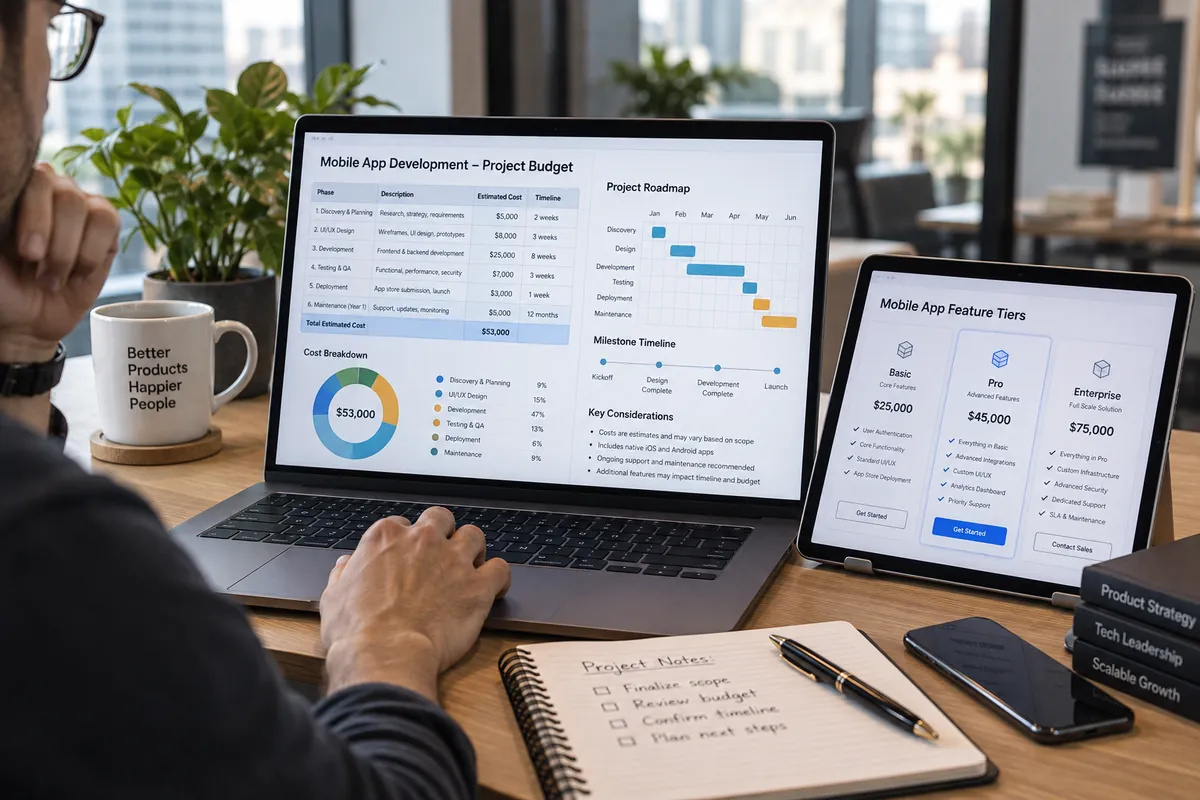
There is no reliable single price for a mobile app without knowing its users, screens, workflows, integrations, platforms and quality requirements. Ask for an estimate based on a written scope and separate build, store, hosting, third-party, support and improvement costs. Treat any price quoted before the scope is written down as a rough guide, not a commitment.
Introduction
Imagine receiving one quote for a booking app and another that is several times higher. One may include an admin dashboard, payment recovery and both platforms; the other may cover only a small set of screens. Until the scope is aligned, the totals do not tell you which project costs less to deliver.
This guide explains how to build a useful estimate for a mobile app in 2026, which expenses sit outside development and how to compare proposals. It does not quote prices, because cost follows scope: an itemised, written estimate for your own brief is the only number worth comparing.
Why app estimates vary
A mobile app may be a simple companion to an existing service or a product with multiple user roles, a custom backend, payments, maps, offline behavior and operational dashboards. Each requirement affects design, implementation, testing and support. Even two apps with a similar number of screens can have very different integration and failure-handling needs.
An estimate also depends on the team’s process, expertise, delivery location, third-party services and the quality bar. That is why a single price-per-screen shortcut can mislead: it ignores data, edge cases, platform differences and work that users never see but rely on.
Describe the product before asking for a quote
Write down who will use the app, the main task it supports and the platforms it must serve. Sketch the key journeys and identify user roles, admin needs, languages, accessibility requirements, offline behavior and any data the app must read or update.
Separate must-have features from later ideas. For every integration, name the system and expected action, such as creating a payment, checking inventory or sending a status update. If a requirement is uncertain, ask for a discovery phase or prototype estimate instead of treating an assumption as a fixed commitment.
The main cost drivers
Interface complexity includes screens, custom interaction, content states and platform-specific behavior. Backend work includes authentication, data models, business rules, admin tools, APIs, permissions and monitoring. Integrations add vendor setup, error recovery, testing and sometimes recurring service charges.
The delivery estimate should also account for design, project management, quality assurance, deployment and documentation. A two-platform release needs testing on each target platform even when code is shared. More users or sensitive data may bring additional reliability and security requirements; those should be defined rather than guessed.
Separate the build from ongoing expenses
Ask which items are one-time project work and which recur: developer program membership, cloud hosting, storage, email or SMS, maps, payment processing, analytics and support. Apple lists its Developer Program membership at 99 US dollars per year in most regions, while Google Play requires a one-time registration fee; check current official terms for your account and region.
Maintenance is not one fixed percentage for every app. It depends on release frequency, platform updates, dependencies, support commitments and planned improvements. Request an itemized support option that says what is included, how work is approved and how urgent issues are handled instead of relying on an unverified blanket rule.
Compare proposals line by line
Send all providers the same brief and ask them to show assumptions, deliverables, exclusions, milestones and acceptance criteria. Confirm whether design, backend, admin, testing, store submission, content, analytics, deployment and handover are included. Ask who owns code, store accounts and signing credentials.
Look for areas where estimates differ and ask each provider to explain the reason. A lower total may be appropriate if the scope is narrower; it is risky only when the missing work is hidden. Compare the cost of reaching the same defined outcome, including what happens when the project changes.
Control cost without weakening the product
Prioritize the core user journey, reuse proven services where they fit, and validate uncertain requirements before building them at scale. Use a prototype to test a technically risky feature. Keep an explicit backlog so new ideas can be considered against time and budget rather than added informally.
Do not save money by removing essential testing, accessibility, secure handling or release planning. If the budget is limited, reduce the number of features or platforms in the first phase while preserving a reliable experience for the users you choose to serve.
A quote request checklist
Provide the target users, platform list, user flows, rough screen inventory, integrations, data sensitivity, launch constraints and must-have acceptance criteria. Ask for a phase-by-phase estimate, payment schedule, change process, source-code ownership, post-launch support and a clear list of third-party charges.
A careful estimate may begin with questions. That is useful: it means the provider is checking assumptions before committing. Ask for a project-specific quote against a defined scope, with assumptions and exclusions stated clearly. Compare proposals with Vaqnova’s mobile app development service, review the related native versus cross-platform decision guide, and use common app planning mistakes to prepare questions about testing and ownership.
Summary
Key Takeaways
- Scope and integrations explain more than a headline price.
- Compare proposals against the same user journeys and deliverables.
- Separate build costs from store, infrastructure, vendor and support expenses.
- Vaqnova’s indicative ranges need owner confirmation before publication as company guidance.
Pitfalls
Common Mistakes to Avoid
- Comparing totals for different scopes.
- Forgetting backend, admin, testing or release work.
- Treating an annual maintenance percentage as universal.
- Spending the full budget on initial features without planning for support.
FAQ
Frequently Asked Questions
Can I get a mobile app cost before writing a full specification?
You can request a discovery or rough scoping estimate, but its assumptions and uncertainty should be explicit. A detailed estimate requires enough information about user journeys, integrations and delivery expectations.
Does cross-platform development always cost less?
No. Shared implementation may reduce duplicated work, but integrations, platform-specific behavior, testing and team experience affect the total. Compare project-specific proposals.
What recurring app expenses should I ask about?
Ask about developer program membership, hosting, storage, messaging, maps, payment processing, monitoring, support, dependency updates and future improvements.
How much should I budget for app maintenance?
There is no universal percentage that applies to every product. Ask providers to define the actual support scope, response expectations, update work and pricing model.
Wrap-up
Final Thoughts
A useful mobile app estimate begins with the work the product must perform and the quality it must sustain. Define the core journeys, align proposal assumptions, separate recurring expenses and validate uncertain requirements before treating a quote as a budget.
References
Sources
Let's talk
Build Your Next Digital Product
Share your target users, required features and integrations with Vaqnova to request a scoped, itemized app estimate.
Talk to Our Team